TPM 2.0 Explained: The Security Chip Protecting Your PC
TPM 2.0 Explained: The Security Chip Protecting Your PC

GAA Nanosheet Transistors: Biggest Chip Shift Since 2011

Wafer-on-Wafer Bonding Breaks AI's Bandwidth Wall
Why Quantum Computers Need 1,000 Qubits for One
TPM 2.0 and Pluton: Hardware Root of Trust Explained
Why Quantum Computing Bet on One Qubit Design
TL;DR: CXL memory pooling lets servers dynamically share DRAM over a cache-coherent interconnect, eliminating the 40% stranded memory waste in data centers. With commercial hardware now shipping and Azure deploying CXL cloud instances, this technology promises to cut memory costs by 50% while enabling composable infrastructure.

The next revolution in data center architecture won't come from faster processors or bigger GPUs. It will come from something far less glamorous: sharing memory. Right now, roughly 40% of all the DRAM installed across hyperscale data centers sits idle at any given moment, a staggering waste of silicon that researchers at Microsoft Azure and Google have documented in production fleets spanning millions of servers. That's billions of dollars in hardware doing absolutely nothing. Compute Express Link, or CXL, is about to change that by letting servers share memory the way we've long shared storage and networking, dynamically, on demand, and without wasting a single gigabyte.
Here's a number that should make any CTO uncomfortable: memory now accounts for up to 44% of the total cost of ownership of a typical compute server. Meta's own research puts the figure at 37% of TCO and 33% of power consumption across their data center fleet. And the economics get worse as you scale up. A server fully loaded with 64 GB DRAM modules costs 17.5 times as much as one using 16 GB modules, because DRAM pricing follows a brutally nonlinear curve. A 32 GB module runs 2.5 times the price of a 16 GB module; jump to 64 GB and you're paying seven times more.
So data center architects do the rational thing: they under-provision. The average server today contains less than 256 GB of system memory. But workloads are bursty and unpredictable. A database server might need 512 GB during peak hours and 100 GB overnight. An AI inference node might demand enormous memory for one model and barely touch it for the next. The result is a paradox: servers simultaneously have too much memory and not enough, because every gigabyte is locked to the machine it was installed in, whether that machine needs it right now or not.
This is the stranded memory problem, and it's been an open secret in the industry for years.
Memory accounts for up to 44% of server total cost of ownership, yet approximately 40% of installed DRAM sits idle across hyperscale data centers. CXL memory pooling targets this trillion-dollar inefficiency.
The idea of sharing resources across computers is as old as computing itself. Time-sharing systems in the 1960s let multiple users share a single mainframe's processor and memory. Ethernet in the 1970s allowed machines to share network bandwidth. Storage area networks in the 1990s decoupled hard drives from individual servers, creating shared storage pools that transformed how enterprises managed data.
Memory, though, has stubbornly resisted this trend. While we've virtualized CPUs, abstracted storage into cloud volumes, and made networking programmable through software-defined approaches, DRAM has remained physically bolted to individual servers. Each machine gets its own private allocation at deployment time, and that allocation doesn't change until someone physically swaps the DIMMs.
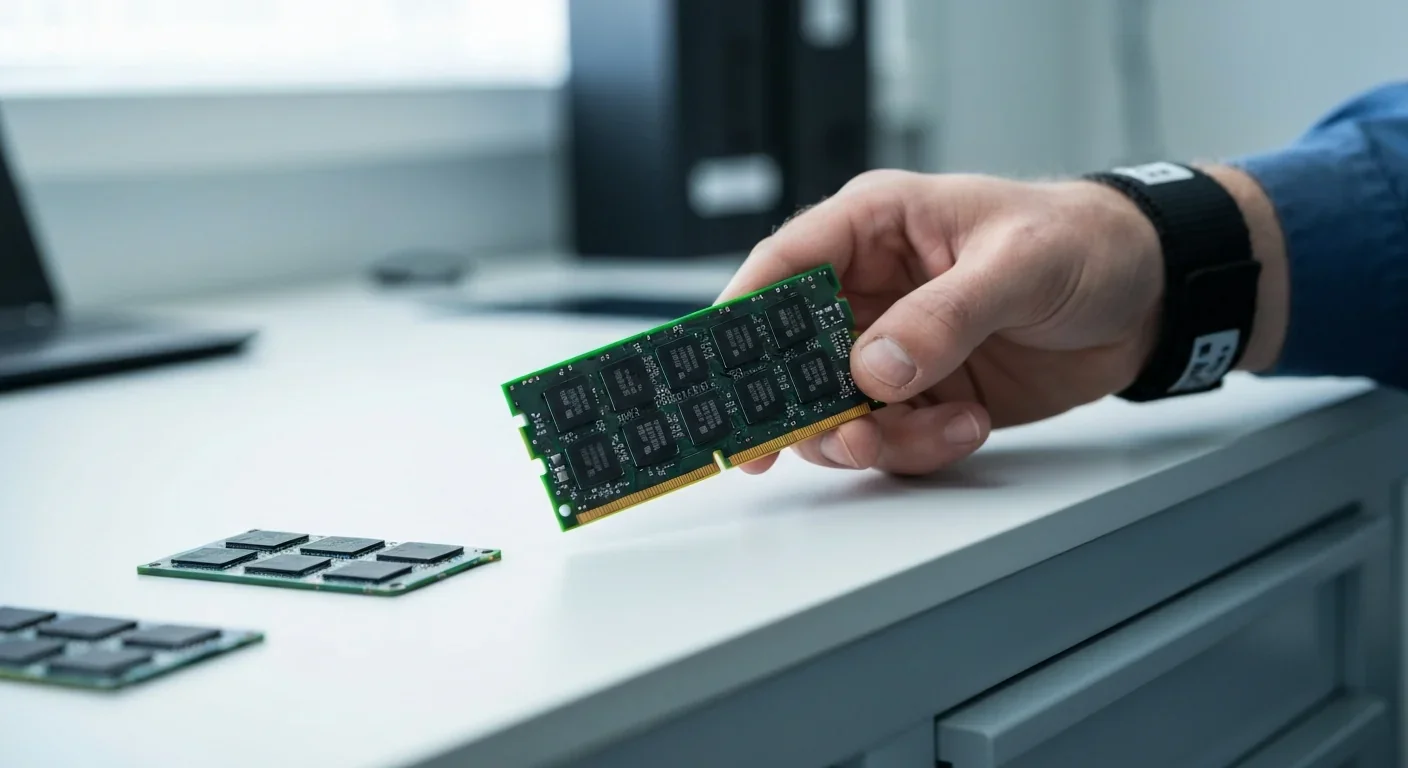
The technical reason is latency. CPUs access local DRAM in roughly 75 to 85 nanoseconds. Any interconnect technology that adds significant delay makes memory-intensive workloads crawl. Previous attempts at remote memory, using RDMA over InfiniBand or Ethernet, introduced latencies of 10 microseconds or more, roughly 100 times slower than local access. That's fine for bulk data transfers but useless for the fine-grained, random access patterns that real applications need.
CXL changes the math entirely. Built on top of the PCIe physical layer that already connects CPUs to GPUs, network cards, and SSDs, CXL adds something PCIe never had: cache-coherent memory access semantics. Through its CXL.mem protocol, a CPU can access memory on a remote device using the same load/store instructions it uses for local DRAM, with the hardware ensuring data consistency automatically. No special APIs, no driver overhead, no application rewrites.
CXL defines three device types, and it's Type 3, the memory expander, that makes pooling possible. A Type 3 device is essentially a box of DRAM connected to the CXL fabric rather than directly to a CPU's memory controller. The host operating system sees this memory as a separate NUMA node, a slower but still directly addressable tier of memory that applications can use transparently.
The protocol stack has three layers that work together. CXL.io handles device discovery and configuration, borrowing directly from PCIe. CXL.cache allows devices to cache host memory coherently. And CXL.mem enables the host to read and write device memory with hardware-enforced coherence, meaning multiple CPUs can share the same memory region without data corruption.
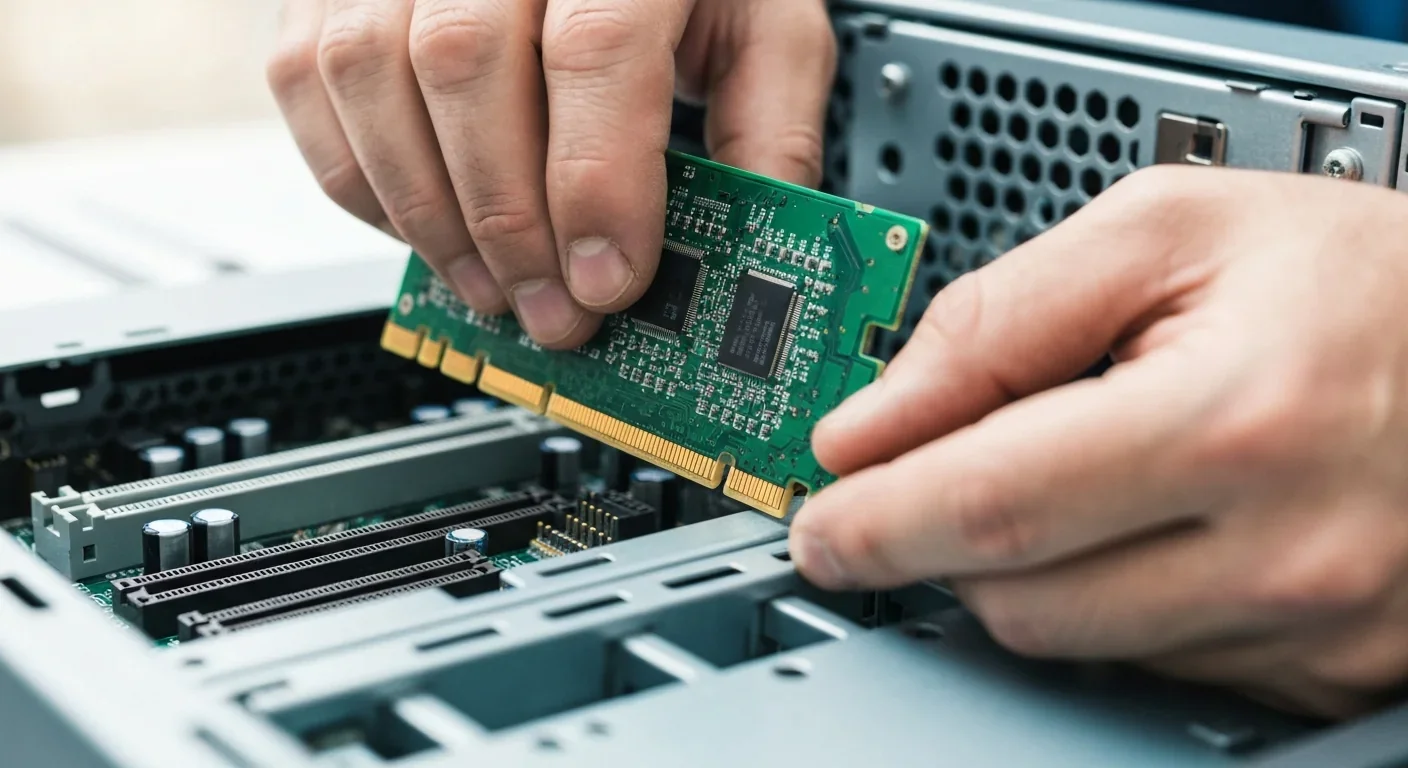
What about the latency penalty? Modern CXL controllers add approximately 70 nanoseconds compared to direct-attached DRAM, and each CXL switch in the path adds roughly another 70 ns. In practice, total CXL-attached memory latency lands in the 130 to 300 nanosecond range, depending on topology. That's roughly two to three times slower than local DDR5, but here's the thing: many workloads can absorb this penalty without meaningful performance loss. Hybrid DRAM-CXL systems already achieve 95 to 100% of pure DRAM throughput while cutting memory costs by 50% through intelligent tiering that keeps hot data local and cold data on CXL.
"By supporting native load/store access semantics over the CXL fabric, our design delivers near-local memory latency."
- Beluga Research Team, CXL Memory Architecture Paper
The bandwidth story is equally compelling. CXL 3.0, built on PCIe 6.0 at 64 GT/s per lane, delivers roughly 70 GB/s, up from 15.2 GB/s in CXL 1.0. The latest CXL 4.0 specification, released in November 2025, doubles bandwidth again to 128 GT/s via PCIe 7.0, enabling 1.536 TB/s of bidirectional throughput on a single x16 link.
Large language models have turned the memory problem into a crisis. Running inference on models with billions of parameters requires enormous memory for the key-value cache alone, and that demand scales with context length and concurrent users. Traditional architectures force operators to provision each GPU server with maximum possible memory, even though utilization fluctuates wildly.
CXL memory pooling offers a way out. In demonstrations using NVIDIA H100 GPUs, XConn Technologies showed that a CXL memory pool delivered 3.8 times the speedup of 200 Gbit RDMA and 6.5 times the speedup of 100 Gbit RDMA for LLM inference. The Beluga architecture, which replaces RDMA with CXL switches, achieved an 89.6% reduction in time-to-first-token and 7.35 times higher throughput for vLLM serving. These aren't incremental gains. They represent a fundamental rethinking of how AI systems access memory.

Commercial CXL memory pools have already scaled to 100 TiB per cluster, providing a cost-effective memory tier that's accessed with minimal CPU involvement. Marvell's new Structera S switch, a 260-lane CXL switching device purpose-built for AI workloads, is expected to begin sampling in Q3 2026.
"Breaking through the AI memory wall requires a fundamental architectural change. The Structera S CXL switch is the first true CXL switching solution purpose-built for AI."
- Rishi Chugh, VP and General Manager, Data Center Switch Business Unit, Marvell
The CXL ecosystem isn't controlled by any single company or country, and that's by design. The CXL Consortium, formed in March 2019 by Intel, now includes over 190 member companies spanning CPU vendors, memory manufacturers, cloud providers, and system integrators. Founding members include Alibaba, Cisco, Dell, Meta, Google, HPE, Huawei, Intel, and Microsoft, a rare alignment of American, Chinese, and European technology giants around a single open standard.
Samsung led early hardware development with a 128 GB CXL memory expansion module in May 2021, later scaling to 512 GB. SK hynix and Micron have followed with their own CXL DRAM products. On the infrastructure side, Microsoft Azure launched the industry's first CXL-equipped cloud instances in November 2025 using Astera Labs Leo controllers, marking the transition from lab demos to production workloads.
While Silicon Valley focuses on the AI use case, researchers in Asia are exploring CXL's potential for full-duplex memory architectures that could achieve 55 to 61% bandwidth improvements over conventional DDR5. European institutions are contributing to the coherence models that will determine whether memory pooling can scale beyond individual racks to entire data center floors. The question of who sets the software standards, and who controls the intellectual property around CXL switching, will shape competitive dynamics for years.

CXL memory pooling won't just plug and play. For a platform to deliver pooled memory, the CPU, platform BIOS, switches, Type 3 modules, operating system, telemetry, and provisioning model must all be compatible. Without mature software for isolation, quality of service, and observability, memory pooling introduces operational risk.
The operating system layer needs the most work. Memory allocation descriptors, NUMA-aware policies, and runtime support must be updated to expose pooled memory transparently. Research from production deployments shows that existing Linux memory tiering can cause SLO violations up to 65% in multi-tenant environments without fairness controls. Security is another frontier: researchers have demonstrated hardware-rooted process-level isolation for shared CXL memory with just 3.3% performance overhead, but these mechanisms aren't yet standardized.
For infrastructure planners: CXL 3.0-compliant memory pooling devices are sampling now, with broader availability expected in late 2026. CXL 4.0 multi-rack systems may deploy in late 2026 to 2027. The skill sets that matter most are NUMA-aware tuning, memory tiering policy design, and CXL fabric topology planning.
The trajectory is clear: just as storage moved from direct-attached disks to shared pools, memory is following the same arc. The servers of 2030 will likely treat DRAM the way today's servers treat disk space, as a fungible resource drawn from a shared pool, allocated on demand, and reclaimed when no longer needed. For the billions of dollars currently locked in stranded RAM, that future can't arrive soon enough.

Project Orion was a real 1960s program to reach other stars by detonating 800 nuclear bombs behind a spacecraft. The physics worked and the engineering was feasible, but the 1963 nuclear test ban treaty killed it. It remains the most credible interstellar spacecraft ever designed.

The locus coeruleus, a tiny brainstem structure, degenerates decades before Alzheimer's symptoms appear. Its loss cripples the brain's inflammation control, waste clearance, and sleep regulation. New imaging tools and noradrenergic therapies offer hope for early detection and prevention.

Research shows the sharing economy often increases total resource consumption through the Jevons paradox and rebound effects. Ride-sharing adds billions of vehicle miles, co-working spaces use more energy per worker, and diffused responsibility erodes conservation behavior. Breaking the paradox requires congestion pricing, accountability design, and matching sharing models to appropriate resource types.

Psychological reactance theory explains why banning or restricting things makes people want them more. From Prohibition to the Streisand effect to scarcity marketing, research shows that threatening people's freedom reliably backfires, and autonomy-supportive communication is far more effective.

A carnivorous pitcher plant in Borneo evolved to house bats instead of trapping insects, gaining up to 95% of its nitrogen from bat guano. The plant even built an ultrasonic reflector to help bats find it, revealing that carnivory in plants is a flexible spectrum.

The quantified self movement began as a hacker-ethos pursuit of personal insight, but corporate wearables now funnel biometric data to employers, insurers, and data brokers. With 81% of Americans wrongly believing health apps are HIPAA-protected, a regulatory void enables health data to be sold for pennies while generating anxiety instead of empowerment.
CXL memory pooling lets servers dynamically share DRAM over a cache-coherent interconnect, eliminating the 40% stranded memory waste in data centers. With commercial hardware now shipping and Azure deploying CXL cloud instances, this technology promises to cut memory costs by 50% while enabling composable infrastructure.

Loading featured articles...